Mission-Oriented Automated Enterprise Management
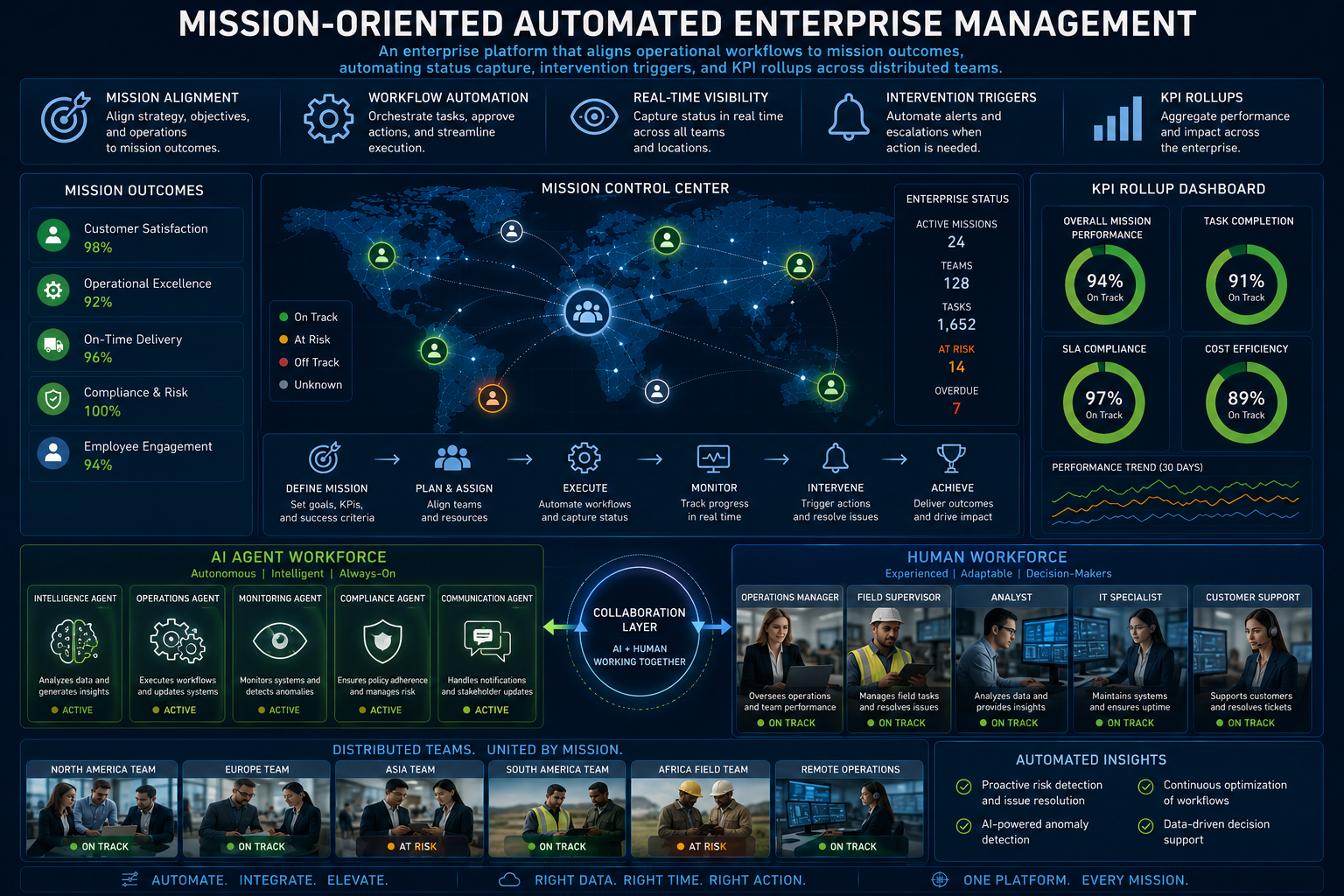
An enterprise platform where AI agents and human teammates coordinate around a common mission — not in parallel, not in replacement. Both subscribe to the same view of mission state, the system routes work to whichever party is best suited to it, and every action — agent or human — stays visible, attributable, and reversible. Throughput from agents, judgment from people, one shared scoreboard.
Key Features
Shared Mission Context
Humans and agents subscribe to the same mission state, so neither side acts on stale or partial views — coordination is the default, not an afterthought.
Capability-Aware Routing
Work flows to whichever party — human or agent — is best matched to the task. Handoffs preserve full context so nothing gets re-derived.
Mixed-Team Audit
Every action attributed to a human or an agent, with intent and outcome captured. Governance and trust scale together instead of trading off.
Challenges
- Keeping humans and AI agents operating from the same understanding of mission state
- Routing work to the right kind of worker — judgment to people, structured execution to agents
- Maintaining trust when actions span human deliberation and agent autonomy
- Auditing decisions across mixed teams without slowing either side down
Solutions
- Shared mission ledger that both humans and agents read and write against
- Capability-aware routing that matches each task to its best-suited executor type
- In-line agent action previews with human confirmation gates when stakes warrant
- Unified audit trail capturing intent, executor (human or agent), and outcome
Project Outcomes
Cut handoff friction between human teams and agent automations
Surfaced mission drift early enough that humans and agents could course-correct together
Produced a single attributable record of who — or what — did what, when, and why
Met DoD audit requirements while preserving agent execution speed