Agent-Centric Automation
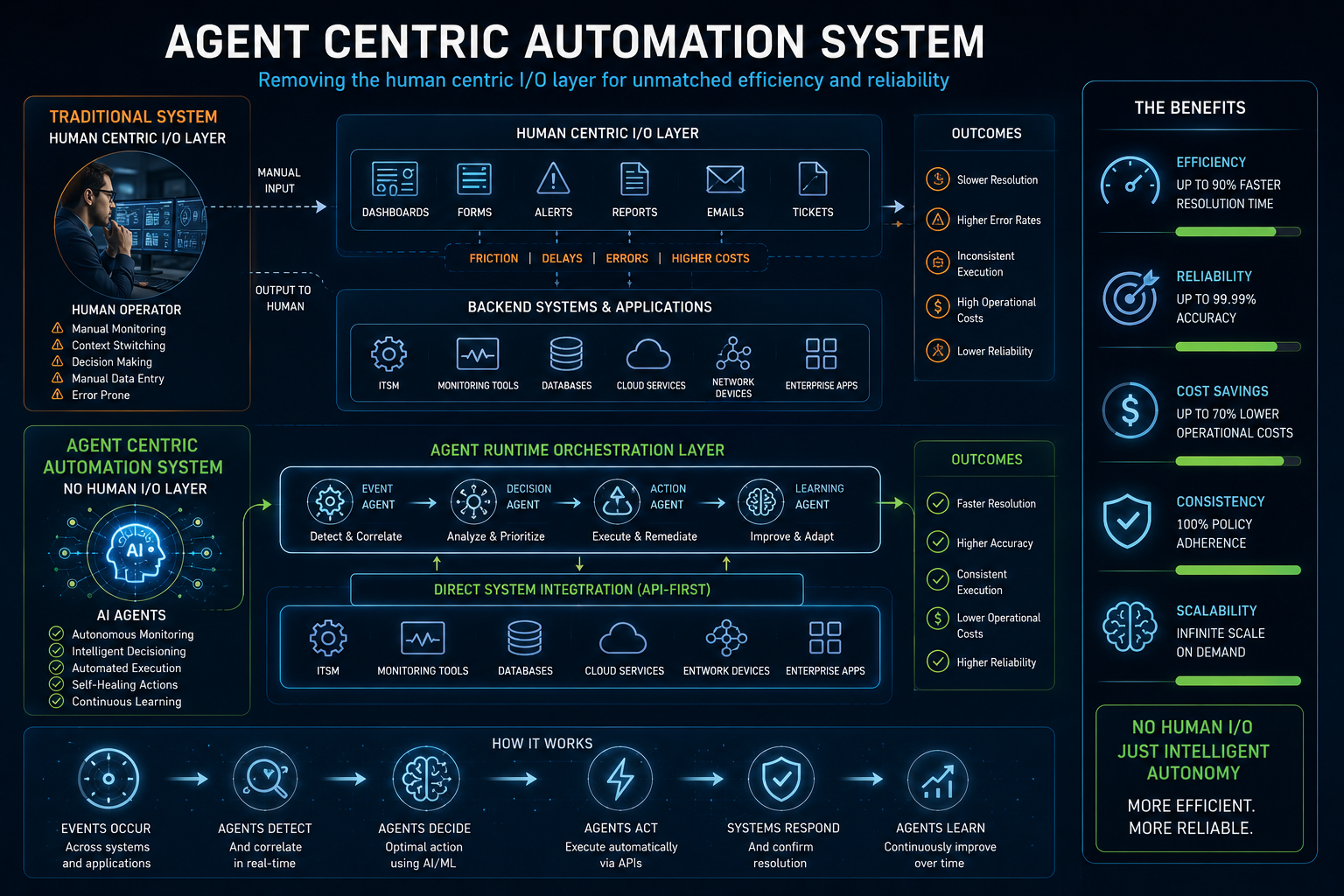
A class of automation systems designed from the ground up for autonomous agents as first-class consumers. Replacing screen-scraping and GUI-driving with typed, machine-native interfaces — function calls, structured schemas, binary protocols — yields dramatic gains in reliability, throughput, and capability surface. Pixels are how humans see; agents have better tools.
Key Features
Typed Tool Contracts
Every agent capability declared as a typed function with explicit inputs, outputs, and side-effect contracts.
Structured Throughput
Pixel-free I/O lets agents operate at the speed of the underlying system, not at the speed of a rendered DOM.
Concurrent Capability Surface
Agents work in parallel against the same machine-native interface, multiplying capability without UI contention.
Challenges
- Existing automation tools were built around human GUIs and screen scrapers — fragile, slow, opaque
- Adapting LLM agents to legacy applications without native API surfaces
- Ensuring reproducibility and auditability of agent-driven actions
- Scaling agent throughput beyond what GUI-driven RPA tooling can sustain
Solutions
- Designed automation around typed function-call contracts rather than visual interfaces
- Built thin agent-native adapters over legacy systems exposing structured tool schemas
- Established deterministic event logs with full input/output capture for replay and audit
- Adopted concurrent agent execution patterns that legacy GUI automation cannot support
Project Outcomes
Eliminated brittleness inherent in screen-scraping and GUI automation
Increased agent throughput by orders of magnitude over RPA-style approaches
Achieved full action-level auditability without human-readable UIs
Expanded agent capability surface to operations no GUI ever exposed